
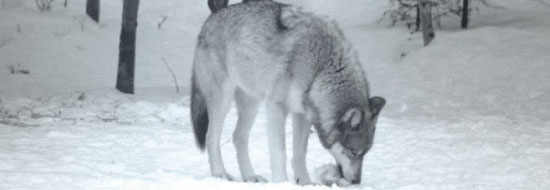
During the winter of 1958 the Canadian Wildlife Service in its continuing policy of wolf control employed several predator officers to exterminate the “hordes of bloodthirsty wolves that were slaughtering the Arctic Caribou”.Along with the government exterminators, naturalist Farley Mowat is also assigned to the mission to investigate this ferocious beast. His findings turn out to be some of the most surprising facts ever seen in animal behavior records.
Mowat was dropped alone on the frozen tundra, where he started his mission to live among the howling wolf packs and study their ways. For his surprise he discovered not a group of killers, but a courageous and skillful animal.
At first it took him weeks to make contact with any wolf at all, but when done, instead of being attacked by the animals the presence of the researcher was simply ignored. For his surprise the watcher had become watched when the first contact was made. A female and a male wolf had been sitting within jumping distance of his unprotected back observing him for several hours while he was trying to spot them with a pair of binoculars. Suffering from both mental and physical strain, the poor man packed his geared and left.
Once the man got adapted to the incredible peacefulness of the wolves he determined it was time to see where they slept at night and where they lingered during the day, just like man do. For his surprise this is what he found. After the first two days and nights of nearly continuous observing these mammals the researcher reached the limits of his endurance. The territory owed by a wolf is comprised for more than a hundred square miles, which made the observation a most frustrating situation. The man did not dare to sleep for fear of missing something vital. On the other hand he had become so sleepy that he was literally seeing “double”, if not triple.
Simple, it had been his fault because he had failed to imitate all the actions of a dozing wolf. That means wolves do not go through those unconscious coma of seven or eights hours of sleep, which represent the human answer to the needed rest. Wolves get their rest by curling up and begin wolf-napping, which is sleeping for an hour, or half an hour and waking up every five minutes to take a look around, stand up and continue their daily routine for other half an hour or two hours, and suddenly “wolf-nap” again for an hour or so. When accustomed to this new life style Mowat found out that a series of properly conducted “wolf-naps” was infinitely more refreshing than the human straight seven or eight hours of sleep.
Wolf talk is another astonishing fact. Our friend the scientist recorded some of the following categories of sounds for communication: Howls, wails, quavers, whines, grunts, growls, yips and barks. After a more detailed observation he found out something else. A long quavering howl which started low, almost inaudible, and ended on the highest note ears would register. This would be used as a means of communication in a line of wolves scattered along miles and miles passing on the message that the largest herbivore in the Arctic, the Caribou or deer of the north, was starting to move towards their territory; amazing networking system.
The Caribou, once as numerous as the plain buffalo in the U.S. had shown a catastrophic decrease during the four decades preceding the trip of Mowat to the Arctic, or the so-called Barren Lands. Supposedly, evidence had been obtained that the plunge of the Caribou toward extinction was primarily due to the depredations of the wolf, and that provided more than sufficient excuse for the adoption of a general campaign for his extermination. Although Mowat had conducted a search diligently for such evidence he had so far found none. There are all sorts of food available for wolves in the arctic to satisfy their appetites, but were they really at hand of these predators? Arctic hares are present, but they are very scarce, besides it would be impossible to feed so many wolves. Birds, like ptarmigan are numerous, but wolves don’t fly. Lake trout, arctic whitefish fill lakes and rivers, but wolves are not so skillful in the water. Therefore, Caribou was the only answer, so wolves should be blame for the killing.
Late one afternoon while Mowat was carrying out one of his observations a female wolf was getting closer to a duck, what a great catch! Food anyway. When the wolf was just about to give one gigantic jump to get its pray, she started yipping like a puppy, and began chasing her tail; she rolled over and over among the rocks. She was just acting as she had gone completely mad. She then jumped again towards the ground “pretending” to get something from the rocks and swallow it, stood up on her hind legs like a horse to throw its rider and came down again with tremendous force. She repeated this peculiar ballet some twenty to twenty five times. What was all this strange ritual?
The spectacle given by this, the most powerful carnivore of North America was nothing else but the ferocious wolf hunting mice. Indeed, these little rodents happen to be the most numerous species in the Arctic, being lemmings the most common; famous in previous investigations fort their suicidal instincts due to their unbelievable reproductive capabilities. One small mouse can give birth to eleven naked offspring, so it is quite understandable the size of the population of these rodents. For his surprise the largest of all wolves, Arctic wolves, were almost living entirely of mice. Caribou, they just hunted the old or sick.
Farley Mowat recorded these and some other amazing findings about the Arctic wolf and started an anti-extermination campaign of these amazing animals. This Canadian researcher is now world-renowned for his superb tales of survival, and conservationism. His books have brought to millions a deeper understanding of the world around us, and this book in particular, Never Cry Wolf, was taken to the big screen as one of Walt Disney’s major motion pictures, almost unknown to any Walt Disney fan by the way.
Now, this is just a brief description of what Farley Mowat has written from his life experience with this magnificent predator. An animal full of strength; ferocious, but noble; intelligent, and naturally gifted with senses that go beyond understanding. Let allow ourselves learn from nature what we can adapt to our urban lives and help protect all those endangered species that still survive. Their extermination will eventually mean the end of the human race as well.
.:M:.
*Escrito originalmente para e.Metro, estación Chapultepec